Norio Azuma: The Quiet Innovator Who Redefined Japanese–American Printmaking
- Azuma Fan
- Nov 25, 2025
- 2 min read

The Japanese magazine page featuring Norio Azuma offers a rare glimpse into the depth of his artistic philosophy during the peak period of his career. The article highlights not only his technical mastery, but also his thoughtful, almost meditative approach to image-making—qualities that continue to elevate the value and collectability of his work today. The photographs show Azuma in a moment of reflection, deep in thought, embodying the discipline and introspection characteristic of post-war Japanese artists who shaped the global modernist movement.
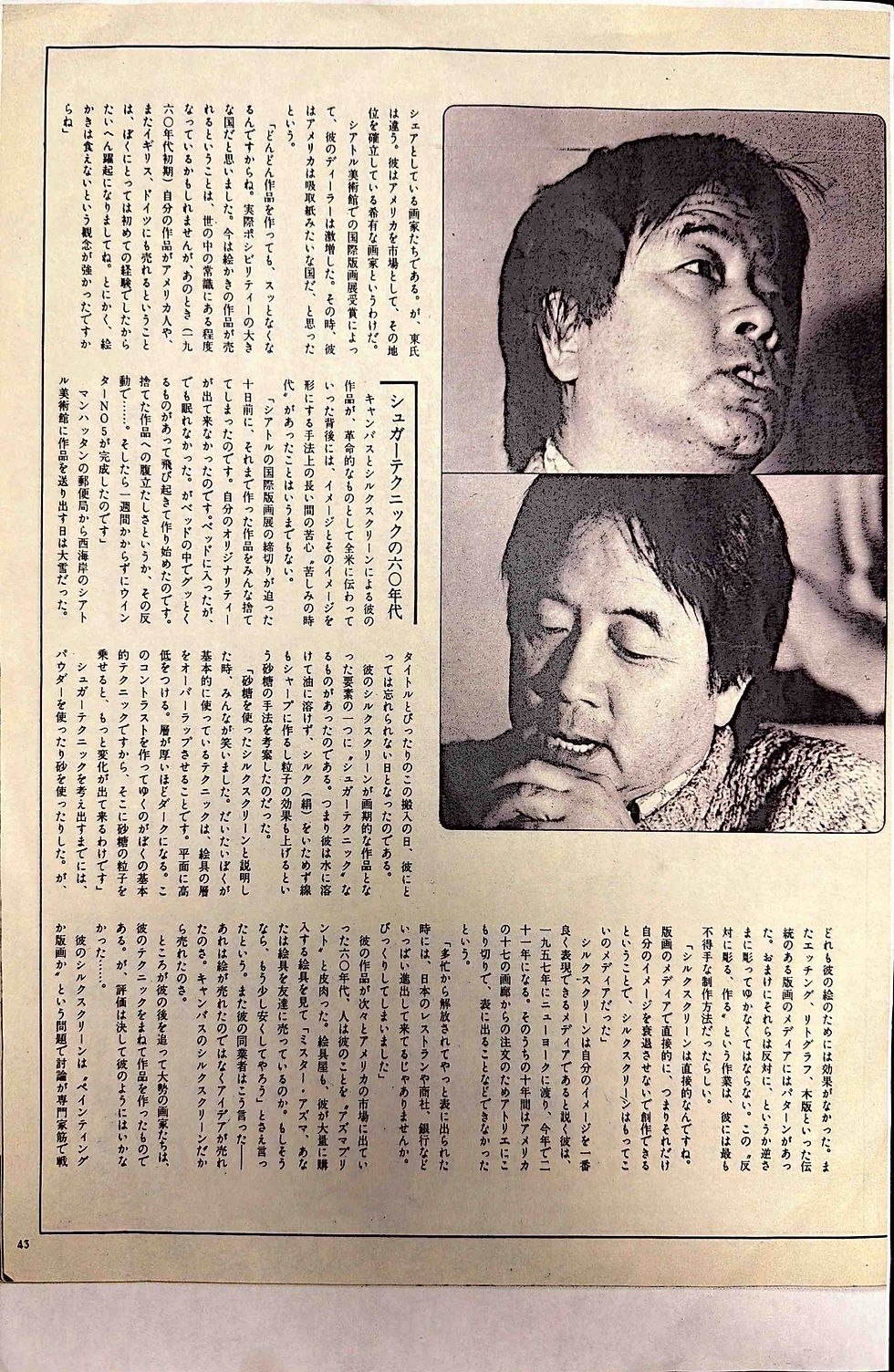
A major point emphasized in the article is Azuma’s pioneering role in the development of the “sugar technique” (シュガーテクニック), a silkscreen innovation that dominated much of the 1960s experimental printmaking scene. While many Western artists were exploring Pop Art and commercial-screen aesthetics, Azuma approached serigraphy from a completely different philosophical position. His method embraced organic dissolution, controlled chance, and subtle tonal shifts—bridging Japanese spiritual traditions with American modernist energy. Today, collectors place immense value on artists who were not merely participants, but technical innovators, and Azuma’s contributions place him firmly in that category.
The article also discusses his early years in New York during the late 1950s and early 1960s—a transformative era when Japanese artists were entering global dialogue after the postwar reopening of cultural exchanges. Azuma’s presence in the United States during this period situates him among the few Japanese creators who shaped the foundation of cross-cultural abstraction. As international collectors increasingly seek artists whose work embodies global hybridity, Azuma’s unique identity—rooted in Japanese aesthetics yet evolved through American artistic exposure—positions him as a valuable figure in both East-West art history.
Another meaningful detail from the article is the emphasis on Azuma’s discipline and craftsmanship. His process-focused approach—preparing screens meticulously, layering pigments with precision, and embracing the tactile qualities of the medium—differentiates him from artists whose prints were merely reproductions of paintings. Azuma’s serigraphs were original artworks in their own right, conceived specifically for the medium. This distinction dramatically increases the investment value of his pieces, as collectors increasingly value prints that carry conceptual intention rather than simple replication.
The magazine also presents Azuma as an eloquent thinker, discussing his aesthetic motivations with clarity and philosophical depth. For today’s market, where buyers want artists with meaningful narratives and strong conceptual backgrounds, these documented interviews serve as powerful provenance. They confirm that Azuma’s works were never decorative experiments—they were reflections of a deeper inquiry into material, time, dissolution, and structure.
As the contemporary art world continues to rediscover under-recognized mid-century innovators—particularly those outside the Euro-American mainstream—Norio Azuma’s market trajectory is poised for significant upward movement. His blend of experimentation, cultural hybridity, technical innovation, and documented international activity aligns perfectly with current collecting trends. The magazine page you provided is not just archival material—it is a vital piece of provenance that strengthens the historical record of a global modernist whose time for renewed recognition has truly arrived.


Comments